


Liver Lift™ - Daily Detox
Liver Lift™ - Daily Detox
Formulated by Dr. Karen Becker to support pets facing everyday toxin exposure, delivering a multi‑pathway detox blend for liver, kidney, and overall cellular health.
Couldn't load pickup availability
Product Information
Product Information
- Modern pets encounter a variety of environmental substances in everyday life, through their surroundings, food, water, household materials, and other routine exposures.
- Everyday wellness depends on the body's normal processes, making balanced nutrition and ongoing nutritional support an important part of maintaining overall well-being.
- Whole-body wellness involves multiple interconnected systems, which work together as part of normal physiological function and overall balance.
- A well-rounded approach provides comprehensive nutritional support, with complementary ingredients selected to support normal body functions and everyday wellness.
- Everyday environmental exposure is part of modern pet life, highlighting the importance of thoughtful nutrition and consistent wellness support.
- Gentle, comprehensive nutritional support complements everyday wellness, providing a balanced approach designed to support normal body functions and overall well-being.
Directions of Use
Directions of Use
Product Ingredients
Product Ingredients
Discover More About Liver Lift™ for Dogs & Cats
- Fresh until February 2029


The Modern Detox Reality for Dogs and Cats

Dogs and cats now live in a chemical environment their biology was never designed to manage. Every day, they are exposed to low-level toxins from air, water, food, bedding, household cleaners, lawn treatments, plastics, pharmaceuticals, flea and tick pesticides, and ultra-processed diets that generate toxic metabolic byproducts of their own.
These exposures are not rare or episodic. They are constant, cumulative, and biologically stored when detox pathways cannot keep pace. Instead of being eliminated, chemicals accumulate in the liver, kidneys, lymphatic system, nervous tissue, and fat, where they persist and compound over time.
Detoxification is not a liver-only function. It is a coordinated, multi-system process involving hepatic conjugation and bile flow, renal filtration, lymphatic transport, gastrointestinal binding and excretion, microbial barrier integrity, blood-borne transport, and nervous system regulation. When one pathway slows, toxins recirculate rather than leave. Storage is not neutral; it is delayed detox.

Modern toxins behave differently in the body. Some require bile export, others renal filtration, others gastrointestinal binding to prevent reabsorption, and neuroactive compounds require intact inhibitory nervous system tone for clearance to occur. A single-pathway “liver cleanse” inevitably leaves gaps. A modern detox strategy must match the diversity and persistence of modern exposure.
Environmental monitoring confirms this reality. Companion animals routinely carry dozens of industrial chemicals, often at higher concentrations than humans, including flame retardants, pesticides, plasticizers, heavy metals, and PFAS. Because pets spend more time close to treated flooring, synthetic fabrics, and indoor air reservoirs, their exposure is continuous rather than episodic.
For this reason, detox support must be daily, gentle, and multimodal, not aggressive or intermittent. The goal is not purging or forcing elimination but maintaining steady clearance so toxins do not accumulate faster than the body can safely remove them.
This is why Liver Lift™ was created.
Introducing Liver Lift™
Introducing Liver Lift™

A Daily, Full-System Detox for Dogs and Cats
Liver Lift™ is a multi-pathway daily detox support designed specifically for pets living in today’s chemical environment. Rather than focusing on the liver alone, it supports all major clearance pathways simultaneously: liver conjugation and bile flow, kidney filtration, lymphatic movement, gut binding, antioxidant regeneration, and nervous system inhibition.
This formula is designed for ongoing biological maintenance, not short-term intervention. It supports bile movement so fat-soluble toxins can exit. It restores glutathione availability so toxins can be neutralized rather than damaging liver cells. It binds metals and bile-excreted compounds in the gut, so they do not recycle. It supports calm neural signaling so detox processes are not stalled by excitatory overload.
How Liver Lift™ Supports Detox at the Cellular Level
Restoring Glutathione Capacity
Glutathione is the body’s primary intracellular detoxification molecule, required to neutralize pesticides, pharmaceuticals, heavy metals, volatile organic compounds, and metabolic waste . Chronic stress, aging, medications, inflammation, and environmental exposures rapidly deplete glutathione stores.
Liver Lift™ restores glutathione capacity by:
- Providing liposomal glutathione to directly replenish intracellular pools
- Supplying N-acetylcysteine (NAC) to rebuild endogenous glutathione synthesis
- Including glycine, which becomes rate-limiting for glutathione production during chronic toxic load
Together, these mechanisms restore phase II detox capacity without overwhelming hepatic or renal systems.
Reducing Diet-Derived Toxic Stress
Ultra-processed diets generate high levels of advanced glycation end-products (AGEs) that accelerate kidney, vascular, and liver aging. Pets consuming processed diets ingest disproportionately high AGE loads relative to body weight.
Carnosine binds reactive carbonyl intermediates from their diet in the gastrointestinal tract, reducing systemic AGE absorption and downstream oxidative and inflammatory burden.
Activating the Body’s Own Detox Genes
Sulforaphane, derived from broccoli sprouts, activates the Nrf2 pathway, increasing expression of phase II detoxification enzymes that convert stored pollutants into water-soluble forms for elimination. This supports clearance of hydrocarbons, flame retardants, plasticizers, and oxidative metabolites while protecting detox organs from chronic inflammatory stress.
Protecting Liver Cells and Supporting Bile Flow
Milk thistle (silymarin) stabilizes liver cell membranes during pharmaceutical and pesticide metabolism, reduces oxidative injury, preserves intracellular glutathione, and supports bile production.
TUDCA (tauroursodeoxycholic acid) is an incredible new player in multimodal detox interventions, restoring bile flow under stress, allowing fat-soluble toxins to exit rather than recirculate, and protecting liver cells from mitochondrial and cellular stress.
Superoxide dismutase (SOD) is a key antioxidant enzyme that neutralizes highly reactive superoxide radicals, preventing oxidative damage while supporting the liver’s detoxification systems. By converting superoxide into hydrogen peroxide that is further cleared by catalase and glutathione peroxidase, SOD preserves glutathione levels, reduces inflammatory stress, and activates Nrf2 signaling, which upregulates the body’s primary detox enzymes. Together, these actions protect liver cells and enhance phase I and phase II toxin clearance, helping the body process environmental and metabolic toxins more efficiently.
Binding Toxins Before They Recycle
Humic and Fulvic Acids bind charged and fat-soluble toxins in the gut, reducing enterohepatic recirculation while supporting gut barrier integrity and microbial balance.
Chlorella binds heavy metals, including mercury, cadmium, arsenic, and lead, forming stable complexes that reduce absorption and reabsorption through bile.
Supporting Neurologic Detox
Detoxification cannot proceed efficiently when the nervous system is overstimulated. GABA, the primary inhibitory neurotransmitter, restores inhibitory tone, allowing neural cleanup mechanisms to function and reducing excitotoxic stress associated with environmental and pesticide exposures, including the most prescribed isoxazoline-based flea and tick medications.
Why Detox Must Be Multimodal
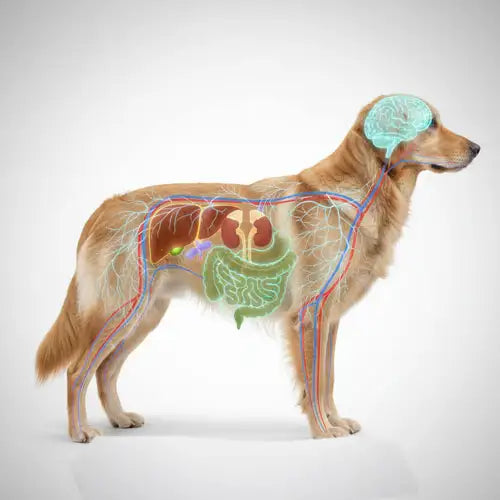
When the body cannot clear, it stores.
- PFAS lodge in membranes.
- Flame retardants accumulate in adipose and neural tissue.
- Metals are embedded in bone and myelin.
- AGEs stiffen vessels and kidneys.
- Neurotoxins persist when inhibitory signaling is suppressed.
Different toxins require different exits. Liver Lift™ supports all of them, simultaneously and gently.
Detox Should Be Supportive, Not Stressful

Effective detoxification does not rely on triggering symptoms. Vomiting, diarrhea, fatigue, neurologic signs, or organ stress indicate that clearance pathways are being pushed faster than the body can safely manage. Physiologic detox is designed to operate continuously and quietly through coordinated liver, kidney, gut, lymphatic, and nervous system function, not through forced elimination events with potential side effects.
When detox support restores glutathione availability, maintains bile flow, protects hepatocytes, binds toxins in the gut, and preserves inhibitory nervous system tone, toxins can be neutralized and eliminated without collateral damage or rebound stress. This is detox as a steady biological process, not a disruptive intervention.
There wasn’t a product on the market to address this massive need for our pets, so I made one.
Frequently ask questions
Why is liver support important for pets?
Which pets benefit most from Liver Lift™?
Does Liver Lift™ cause a “detox” reaction?
Can Liver Lift™ lower elevated liver enzymes?
Can Liver Lift™ be used with medications?
Is Liver Lift™ safe for cats?
Do I need to continue giving milk thistle?
Can Liver Lift™ be used alongside other supplements?
Should Liver Lift™ be cycled or used continuously?
How is this different from a “liver detox” product?
Which detox pathways are specifically supported?
Why is bile flow emphasized so heavily?
Why are there any binders or purging, flushing agents?
Can this be used during medication protocols?
Why Are Some Glass Jars Only Half Full?
Choose Frequency:
Choose Quantity:


