


Introducing Liver Lift™
Introducing Liver Lift™

A Daily, Full-System Detox for Dogs and Cats
Liver Lift™ is a multi-pathway daily detox support designed specifically for pets living in today’s chemical environment. Rather than focusing on the liver alone, it supports all major clearance pathways simultaneously: liver conjugation and bile flow, kidney filtration, lymphatic movement, gut binding, antioxidant regeneration, and nervous system inhibition.
This formula is designed for ongoing biological maintenance, not short-term intervention. It supports bile movement so fat-soluble toxins can exit. It restores glutathione availability so toxins can be neutralized rather than damaging liver cells. It binds metals and bile-excreted compounds in the gut, so they do not recycle. It supports calm neural signaling so detox processes are not stalled by excitatory overload.
How Liver Lift™ Supports Detox at the Cellular Level
Restoring Glutathione Capacity
Glutathione is the body’s primary intracellular detoxification molecule, required to neutralize pesticides, pharmaceuticals, heavy metals, volatile organic compounds, and metabolic waste . Chronic stress, aging, medications, inflammation, and environmental exposures rapidly deplete glutathione stores.
Liver Lift™ restores glutathione capacity by:
- Providing liposomal glutathione to directly replenish intracellular pools
- Supplying N-acetylcysteine (NAC) to rebuild endogenous glutathione synthesis
- Including glycine, which becomes rate-limiting for glutathione production during chronic toxic load
Together, these mechanisms restore phase II detox capacity without overwhelming hepatic or renal systems.
Reducing Diet-Derived Toxic Stress
Ultra-processed diets generate high levels of advanced glycation end-products (AGEs) that accelerate kidney, vascular, and liver aging. Pets consuming processed diets ingest disproportionately high AGE loads relative to body weight.
Carnosine binds reactive carbonyl intermediates from their diet in the gastrointestinal tract, reducing systemic AGE absorption and downstream oxidative and inflammatory burden.
Activating the Body’s Own Detox Genes
Sulforaphane, derived from broccoli sprouts, activates the Nrf2 pathway, increasing expression of phase II detoxification enzymes that convert stored pollutants into water-soluble forms for elimination. This supports clearance of hydrocarbons, flame retardants, plasticizers, and oxidative metabolites while protecting detox organs from chronic inflammatory stress.
Protecting Liver Cells and Supporting Bile Flow
Milk thistle (silymarin) stabilizes liver cell membranes during pharmaceutical and pesticide metabolism, reduces oxidative injury, preserves intracellular glutathione, and supports bile production.
TUDCA (tauroursodeoxycholic acid) is an incredible new player in multimodal detox interventions, restoring bile flow under stress, allowing fat-soluble toxins to exit rather than recirculate, and protecting liver cells from mitochondrial and cellular stress.
Superoxide dismutase (SOD) is a key antioxidant enzyme that neutralizes highly reactive superoxide radicals, preventing oxidative damage while supporting the liver’s detoxification systems. By converting superoxide into hydrogen peroxide that is further cleared by catalase and glutathione peroxidase, SOD preserves glutathione levels, reduces inflammatory stress, and activates Nrf2 signaling, which upregulates the body’s primary detox enzymes. Together, these actions protect liver cells and enhance phase I and phase II toxin clearance, helping the body process environmental and metabolic toxins more efficiently.
Binding Toxins Before They Recycle
Humic and Fulvic Acids bind charged and fat-soluble toxins in the gut, reducing enterohepatic recirculation while supporting gut barrier integrity and microbial balance.
Chlorella binds heavy metals, including mercury, cadmium, arsenic, and lead, forming stable complexes that reduce absorption and reabsorption through bile.
Supporting Neurologic Detox
Detoxification cannot proceed efficiently when the nervous system is overstimulated. GABA, the primary inhibitory neurotransmitter, restores inhibitory tone, allowing neural cleanup mechanisms to function and reducing excitotoxic stress associated with environmental and pesticide exposures, including the most prescribed isoxazoline-based flea and tick medications.
Why Detox Must Be Multimodal
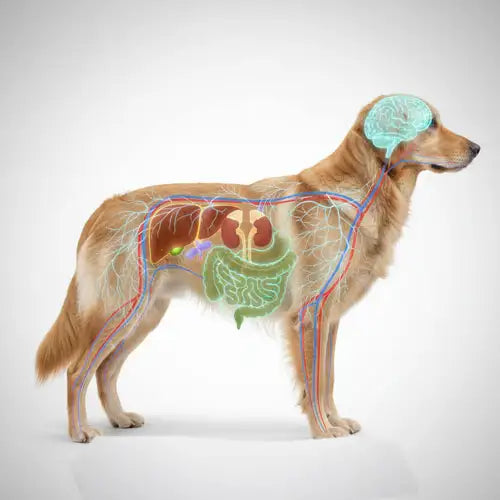
When the body cannot clear, it stores.
- PFAS lodge in membranes.
- Flame retardants accumulate in adipose and neural tissue.
- Metals are embedded in bone and myelin.
- AGEs stiffen vessels and kidneys.
- Neurotoxins persist when inhibitory signaling is suppressed.
Different toxins require different exits. Liver Lift™ supports all of them, simultaneously and gently.


