



Story Highlights
- False pregnancy is a normal hormonal event that affects up to 75% of intact female dogs, even if they've never been bred.
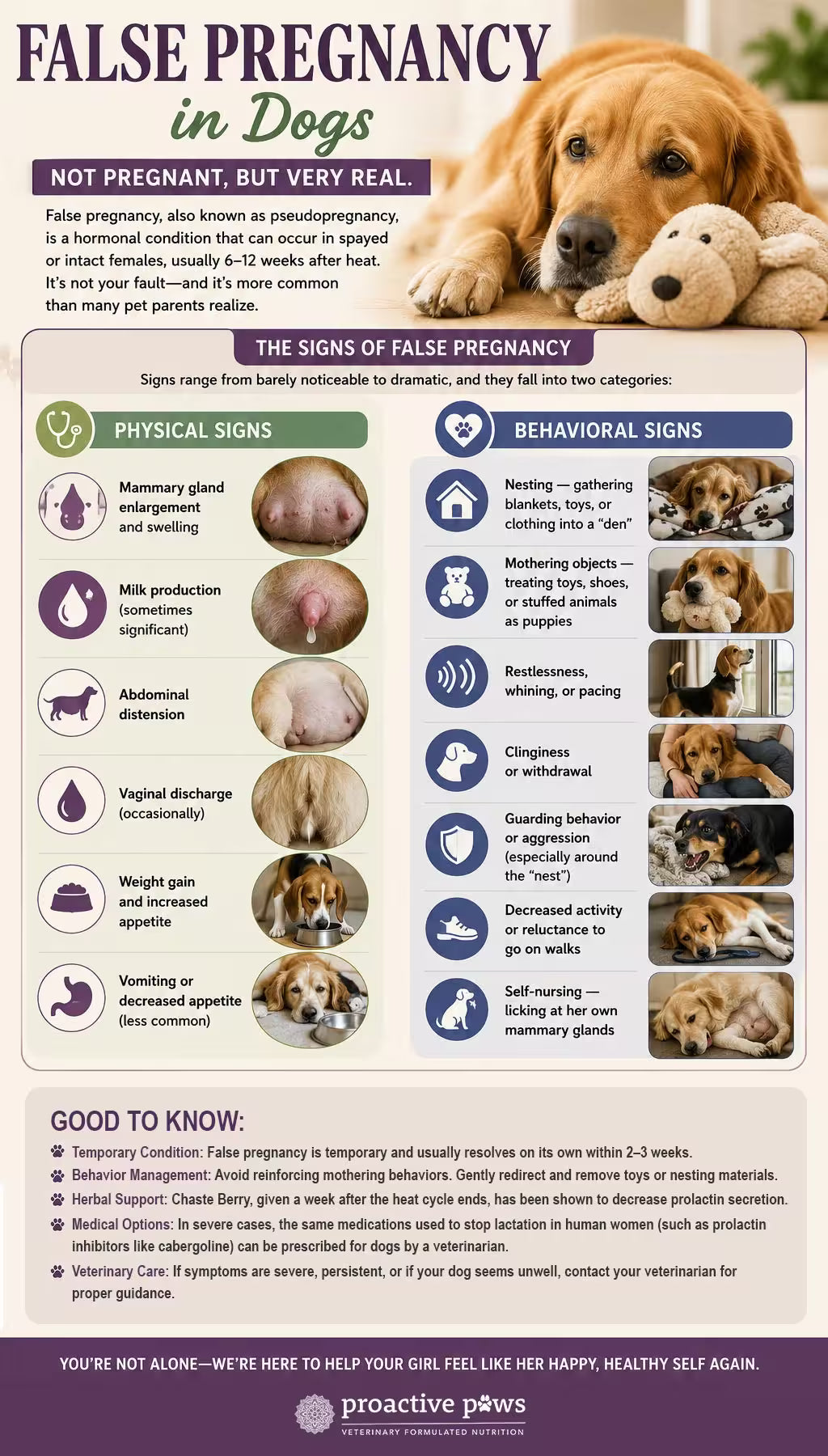
- Signs usually appear 6 to 12 weeks after a heat cycle and can include nesting, milk production, swollen mammary glands, and mothering toys.
- Your dog isn't "pretending." A surge in prolactin convinces her body and brain that puppies are on the way.
- Most cases resolve naturally within a few weeks, but supportive care can make your dog much more comfortable.
- Removing mothering objects, preventing self-nursing, increasing exercise, and providing mental enrichment can help shorten episodes.
- Understanding what's happening hormonally helps you respond with patience and compassion instead of worry.
What Is False Pregnancy?
Few things surprise pet parents more than watching their dog carefully gather stuffed animals into a nest, produce milk, and fiercely protect her favorite toy as though it were a newborn puppy. Many assume an accidental breeding must have occurred. Others fear something is seriously wrong.
In reality, your dog may be experiencing one of the most fascinating hormonal events in canine biology: false pregnancy, also known as pseudopregnancy or pseudocyesis, a condition where a female dog shows signs of pregnancy even though she hasn't been bred.
Despite the alarming symptoms, false pregnancy isn't a disease; it’s a normal hormonal event/biological response that occurs after a heat cycle in many intact females. In fact, it's so common that many veterinarians consider it a normal part of the canine reproductive cycle rather than a medical disorder. Most dogs recover completely with supportive care, patience, and a little understanding of what's happening inside their bodies.
After every heat cycle, a dog's body goes through the same hormonal changes regardless of whether or not she's pregnant.
Following ovulation, progesterone rises and remains elevated for roughly two months. This hormone prepares the body to support a pregnancy. Whether puppies are present or not doesn't matter. Every intact female dog enters this phase.
Eventually, progesterone naturally falls. As it declines, another hormone called prolactin surges. Prolactin is the hormone responsible for maternal instincts; milk production, nesting behaviors, and caring for offspring.
For many dogs, this hormonal transition passes unnoticed. But for others, the prolactin surge is strong enough to produce visible physical and behavioral changes that look remarkably like genuine pregnancy, convincing both body and brain that puppies are about to arrive.
Studies estimate that pseudopregnancy affects anywhere from 50–75% of intact female dogs1 at some point in their lives, though many cases are mild enough that owners never notice. It typically appears 6–12 weeks after the end of a heat cycle. The timing is no coincidence. It is exactly when a truly pregnant dog would be preparing to deliver puppies.
From an evolutionary perspective, this response may have helped wild canids survive. Wolves, African wild dogs, and other social canids often raise puppies cooperatively. Females who were not pregnant could still produce milk and help care for the dominant female's litter, improving the pack's overall survival.
What seems unusual in our homes today may once have been an important survival strategy.
Can Spayed Dogs Have False Pregnancies?
Yes, depending on the type of sterilization your dog received. Dogs that have undergone a traditional spay (ovariohysterectomy or ovariectomy) will not experience false pregnancy because their ovaries have been removed, eliminating the hormonal cycle that drives it. Once healing is complete, these dogs no longer experience pseudopregnancy.
There is one exception. If a traditional spay is performed during the weeks immediately following ovulation (luteal phase), when progesterone levels are naturally high, removing the ovaries causes progesterone to fall abruptly. That sudden hormonal change can trigger a temporary prolactin surge, leading to a short-lived false pregnancy.
Dogs that have undergone an ovary-sparing spay (OSS) hysterectomy (OSH)2 also known as a hysterectomy, retain their ovaries. Their uterus is removed, but their ovaries continue to cycle hormonally, even though they cannot become pregnant. This means they can, and often do, experience false pregnancy. Because these dogs will cycle for life, false pregnancy may be a recurring event. Management is the same as for intact dogs (outlined below), and pet parents with OSS dogs should be prepared for this possibility.
If episodes are frequent or severe, chaste berry given during the post-estrus period (starting a week after heat) can may help reduce the prolactin surge.3 In rare cases where false pregnancies are severely distressing and recurrent, management with the human medication cabergoline to stop lactation is recommended.
Signs That Your Dog May Be Experiencing a False Pregnancy

Every dog responds differently. Some develop slightly enlarged mammary glands and sleep a little more than usual. Others become devoted mothers to tennis balls, slippers, or stuffed animals, carrying them gently from room to room and refusing to let anyone near their "babies."
Common physical signs include mammary enlargement, milk production, abdominal enlargement, mild weight gain, changes in appetite, and occasionally a small amount of vaginal discharge.
Behavioral changes are often even more noticeable. Dogs may build nests from blankets or laundry, collect favorite toys, become unusually clingy, pace, whine, seem restless, or withdraw from family activities. Some become protective of their nesting area or display aggression toward other pets. Others spend hours licking their mammary glands, which unfortunately stimulates even more milk production.
Although these behaviors may seem unusual, they're driven entirely by hormones rather than conscious choice.
Some dogs show only mild mammary swelling and a bit of nesting. Others produce enough milk to soak their bedding and become intensely protective of adopted "puppies." Both ends of the spectrum are normal variations of the same hormonal process.
When to See Your Veterinarian
Most cases of false pregnancy resolve on their own within 2–3 weeks. However, contact your veterinarian if:
| Mammary glands become hot, hard, red, or painful (possible mastitis) | Symptoms persist beyond 3–4 weeks without improvement |
| Your dog develops a fever, stops eating, or becomes lethargic | Milk production is heavy and not resolving |
| Behavioral changes are severe: aggression, extreme anxiety, or complete withdrawal | You're unsure whether she could actually be pregnant (intact dogs only) |
Your vet can confirm the diagnosis with a physical exam and, if needed, an ultrasound or relaxin test to rule out true pregnancy in intact dogs. Relaxin is a specific diagnostic blood test used to distinguish true canine pregnancy from pseudopregnancy, as relaxin is only produced by the developing placenta.
Natural Management: What You Can Do at Home
For mild to moderate cases, natural management is often all that's needed. The goal is to reduce prolactin stimulation, discourage maternal behaviors, and keep your dog comfortable while her hormones normalize.
1. Remove Mothering Triggers
This is the single most important step. If your dog is nesting with toys, blankets, or other objects, gently remove them. Allowing her to "mother" these items reinforces the hormonal feedback loop: the more she nurtures, the more prolactin her body produces, and the longer the false pregnancy lasts. Replace nesting behavior with gentle walks, enrichment activities, and calm interaction.
2. Prevent Self-Nursing
If your dog is licking her mammary glands, use an E-collar or recovery suit to prevent access. Licking stimulates further milk production through the same prolactin feedback loop. Do not express milk manually or apply warm compresses; both will increase production. If the glands are uncomfortable, briefly apply cool (not cold) compresses to help reduce swelling without stimulating milk flow.
3. Increase Exercise and Mental Stimulation
Daily walks, sniffing games, puzzle feeders, and gentle play help redirect your dog's focus away from nesting and maternal behaviors. Exercise also helps reduce anxiety and restlessness. Aim for at least two moderate walks per day, adjusted to your dog's fitness level.
4. Short-Term Caloric Restriction
A veterinary study found that a brief period of reduced food intake (starting at about 50% of normal calories for 2–3 days, then gradually returning to full portions over a week) helped resolve mammary enlargement and milk production in 100% of pseudopregnant dogs studied, compared to only 25% of dogs fed normally. This approach appears to work by reducing the metabolic support for milk production. Do not fast your dog completely; temporarily reduce portions, and only for otherwise healthy adult dogs. Ask your vet before trying this with puppies, seniors, diabetic dogs, or dogs with other health conditions.
5. Chaste Berry (Vitex agnus-castus)
Chaste berry is the most scientifically supported herbal option for false pregnancy. Its active compounds (diterpenes) bind to dopamine receptors in the brain and directly suppress prolactin secretion, the same mechanism used by the prescription drug cabergoline, used to reduce prolactin levels in women.4
The study found that Vitex agnus-castus (chaste berry) was clinically comparable to cabergoline for managing canine pseudopregnancy, with both treatments producing significant reductions in clinical signs and serum prolactin levels and achieving complete remission within 30 days. Dogs receiving cabergoline experienced more adverse effects, particularly nausea and vomiting, while side effects with Vitex agnus-castus were less frequent and milder, primarily transient loose stools.
Veterinarians prescribe bromocriptine5 for severe cases. In human clinical studies, Vitex was comparable to bromocriptine for reducing elevated prolactin levels and resolving prolactin-driven symptoms like breast engorgement.
6. Melatonin
Melatonin can help modulate the hormonal shifts that drive pseudopregnancy.6 It supports healthy endocrine cycling and has a calming effect that can reduce anxiety-related behaviors like pacing, whining, and restlessness. Melatonin is very safe in dogs and is widely available. Choose a product without xylitol (which is toxic to dogs).
7. Omega-3 Fatty Acids (Fish Oil)
Omega-3s (EPA + DHA) support a healthy inflammatory balance and skin health, which can help if mammary glands are swollen or uncomfortable.7 Choose phospholipid or triglyceride forms over ethyl esters, which produce more GI symptoms. Always use products bottled in glass, third-party tested for contaminants, and sustainably sourced.
8. Calming Support
The canine brain and gut are deeply connected through the gut-brain axis, which means the microbiome can influence emotional resilience, stress tolerance, and behavioral reactivity. LP815 probiotic for dogs is particularly notable for supporting neurotransmitter balance.8 GABA is a key inhibitory neurotransmitter that helps the brain settle, regulate excitability, and maintain emotional balance.
- L-theanine has successfully decreased anxiety in dogs experiencing anxiety related to storms.9
- Adaptil (DAP) pheromone diffusers or collars, which mimic the calming pheromone produced by nursing mothers, can be helpful.10
- A comfortable space for your pet to relax, away from household commotion, is a good idea.
- Maintain a calm, consistent routine and be available for more affection or less affection, depending on her mood.
What NOT to Do
- Do not punish nesting or mothering behavior. She is responding to powerful hormonal signals, not misbehaving.
- Do not express milk from the mammary glands. This stimulates more production.
- Do not apply warm compresses to swollen glands. Warmth increases blood flow and milk production. Cool compresses can provide comfort if the glands are swollen or tender.
- Do not breed your dog to "fix" false pregnancies. This is a common myth. Breeding does not prevent future episodes, and reproductive hormones may cause false pregnancy to recur after every heat cycle regardless of whether she has had puppies, just like intact females.
When False Pregnancy Becomes a Medical Problem
Fortunately, most false pregnancies resolve naturally within two to three weeks. However, complications occasionally occur.
Milk that accumulates in enlarged mammary glands can sometimes lead to mastitis, a painful bacterial infection. If the glands become hot, swollen, firm, red, or painful, seek veterinary care immediately.
Likewise, dogs that develop fever, lethargy, loss of appetite, severe behavioral changes, persistent milk production lasting more than a month, or symptoms that fail to improve should be evaluated by their veterinarian.
If your dog remains intact and there's any possibility she could actually be pregnant, your veterinarian may recommend ultrasound or blood testing to distinguish pseudopregnancy from a true pregnancy.
Supporting Your Dog Naturally
The encouraging news is that most dogs need very little medical intervention. The goal isn't to fight the hormones but to carefully interrupt the cycle that continues stimulating prolactin production.
One of the most helpful things you can do is quietly remove the objects your dog has adopted as puppies. Stuffed animals, toys, blankets, and shoes often become powerful triggers that reinforce maternal behaviors. Once these "babies" disappear, many dogs gradually lose interest in nesting.
At the same time, try redirecting her attention toward enjoyable activities. Slow-strolling sniff walks (sniffaris), food puzzles, scent games, and interactive play provide healthy mental stimulation while helping reduce anxiety and restlessness.
If she's constantly licking her mammary glands, you may need to prevent access with a recovery suit or Elizabethan collar. Every episode of licking stimulates additional milk production, prolonging the condition. Resist the urge to express the milk yourself. Although it seems helpful, emptying the glands signals the body to produce even more milk.
Prescription Treatment for Severe Cases
If natural management isn't enough, particularly if there is heavy milk production, significant behavioral aggression, or marked distress, your veterinarian can prescribeCabergoline (5 μg/kg/day for 7 days) is dopamine agonist that has become the treatment of choice because it directly suppresses prolactin11 secretion. Studies show that approximately 90% of treated dogs recover within one to two weeks. It is generally well tolerated, with relatively few side effects (and the same medication that has been safely used in women for years).
Preventing Future Episodes
For intact dogs and OSS dogs, false pregnancy can recur after each heat cycle. Options include:
- Chaste berry given preventively during the post-estrus period (starting one week after heat) helps blunt the prolactin surge in dogs with recurrent episodes.
- Deslorelin implants (a GnRH agonist) can temporarily suppress the reproductive cycle and are an option for pet parents who want to preserve ovarian function while preventing cycling. This implant is safe and does not carry long-term side effects.
- Full ovariectomy (spaying): The only permanent solution. Removing the ovaries eliminates the hormonal cycle. For OSS dogs with severe, recurrent episodes that significantly impact quality of life, a complete ovariectomy may ultimately be the kindest choice, but it does mean giving up the hormonal benefits of the retained ovaries.
False pregnancy is not a sign that something is wrong with your dog. It's a normal, if sometimes dramatic, hormonal event. Most cases resolve on their own within a few weeks with simple supportive care: removing mothering triggers, preventing self-nursing, increasing exercise, and keeping your dog comfortable.
Above all, be patient and compassionate. Your dog is experiencing real hormonal and emotional changes. She isn't being difficult; she's being a dog with hormones.
A Little Compassion Goes a Long Way
Watching your dog mothering a stuffed animal or anxiously search for puppies that don't exist can be heartbreaking. But remember, she's responding to powerful hormonal messages that are every bit as real to her as pregnancy itself.
She isn't being dramatic, stubborn, or confused. Her body is simply following a biological program that has existed for thousands of years.
Fortunately, most dogs recover beautifully with Chaste Berry support, and time. By understanding what's happening beneath the surface, you can help your dog move through this temporary hormonal phase with far less stress and much more comfort.
Sources and References:
- 1 Root, A.L., Parkin, T.D., Hutchison, P. et al. Canine pseudopregnancy: an evaluation of prevalence and current treatment protocols in the UK. BMC Vet Res 14, 170 (2018). https://doi.org/10.1186/s12917-018-1493-1
- 2 Kutzler MA. Gonad-Sparing Surgical Sterilization in Dogs. Front Vet Sci. 2020 Jun 12;7:342. doi: 10.3389/fvets.2020.00342. PMID: 32596276; PMCID: PMC7303261.
- 3 Zappone V, Marcoccia R, Gattuso DT, Coppola T, Lombardo A, Di Pietro S, Polisca A, Troisi A, Quartuccio M and Aiudi GG (2026) Clinical evaluation of the efficacy of Vitex agnus-castus compared with cabergoline for the treatment of pseudopregnancy in the bitch. Front. Vet. Sci. 13:1862418. doi: 10.3389/fvets.2026.1862418
- 4 Zappone V, Marcoccia R, Gattuso DT, Coppola T, Lombardo A, Di Pietro S, Polisca A, Troisi A, Quartuccio M and Aiudi GG (2026) Clinical evaluation of the efficacy of Vitex agnus-castus compared with cabergoline for the treatment of pseudopregnancy in the bitch. Front. Vet. Sci. 13:1862418. doi: 10.3389/fvets.2026.1862418
- 5 Sachin Kalaswa, Ravindra Jadav and HC Nakhashi Advances in the management of pseudocyesis in bitch: A review, International Journal of Veterinary Sciences and Animal Husbandry 2024; 9(2): 310-319
- 6 Axnér E. A Pilot Study to Evaluate the Potential of Melatonin Implants to Control Cyclicity in the Bitch. Animals. 2023; 13(8):1316. https://doi.org/10.3390/ani13081316
- 7 Carlisle, C.; Metzger, B.T.; Tintle, N.L.; Polley, K.; Jackson, K.H.; Le Brun-Blashka, S.; Griffiths, J.; Harris, W.S. The Effects of Omega-3 Supplementation on the Omega-3 Index and Quality of Life and Pain Scores in Dogs. Animals 2024, 14, 3108. https://doi.org/10.3390/ani14213108
- 8 Bijaoui EMM, Zimmerman NP. Efficacy of a Novel Lactiplantibacillus plantarum Strain (LP815TM) in Reducing Canine Aggression and Anxiety: A Randomized Placebo-Controlled Trial with Qualitative and Quantitative Assessment. Animals (Basel). 2025 Aug 4;15(15):2280. doi: 10.3390/ani15152280. PMID: 40805070; PMCID: PMC12345577.
- 9 Journal of Veterinary Behavior Date: July–August 2015 Pages: 324-331
- 10 Journal of Veterinary Behavior Date: November–December 2020 Pages: 36-42 Volume: Volume 40
- 11 Theriogenology Volume 66, Issues 6–7, October 2006, Pages 1560-1567
About Karen Shaw Becker, DVM, CVH, CVA, CCRT
Veterinarian Dr. Karen Shaw Becker believes biologically appropriate food and an animal's immediate environment are essential in determining health, vitality, and lifespan. She has spent her career as a wildlife and exotic animal veterinarian and small animal clinician, empowering animal guardians to make intentional lifestyle decisions to enhance the well-being of their animals.


