



Story Highlights
- Cancer usually doesn't announce itself dramatically. Persistent limping, unexplained lethargy, appetite changes, straining to urinate or defecate, and bad breath are all early warning signs worth a veterinary visit, especially in predisposed breeds.
- Environmental chemical exposure appears to be playing a larger role in canine cancer than we once assumed, with new genetic research directly linking VOCs and herbicides like 2,4-D and glyphosate to DNA damage in dogs with lymphoma.1-3.
- The old myth that fine needle aspirations "spread" cancer has no scientific support. Veterinary and human research consistently shows no meaningful increase in metastasis risk from properly performed biopsies.
- A true integrative cancer protocol isn't just a list of supplements. It's built on three pillars: immune support, anti-inflammatory strategies, and targeted therapies matched to the specific cancer.
- Not every natural remedy works alongside conventional treatment. Strong antioxidants can hinder the effects of certain chemotherapy drugs rather than enhance them, so timing and selection matter.
Why I Wanted to Have This Conversation
Cancer is one of the diagnoses that pet parents fear most. But that diagnosis doesn’t mean there are no options or no hope. It means it’s time to slow down, gather information, understand exactly what you’re dealing with, and be ready to make well-informed decisions.
I recently sat down with my friend and colleague Dr. Trina Hazzah, a veterinary oncologist who has spent her career blending conventional and integrative approaches to cancer care. We covered a lot of ground: the early warning signs owners routinely miss, whether the types of cancer we're seeing are shifting, the environmental factors that keep showing up in the research, a persistent myth about diagnostic testing that I want to put to rest once and for all, and how to build an integrative protocol that helps rather than undermines conventional treatment.
If you share your life with a middle-aged or senior pet, or if you've already experienced cancer with a beloved pet, I hope this information helps you feel more informed and less frightened.
Cancer Often Starts With a Whisper
Cancer rarely shows up wearing a name tag. It usually appears as something small and easy to explain away, which is why so many cases get caught late. Sometimes the first signs are subtle.
Persistent Limping is one of the big ones. It's natural to assume your dog strained a muscle on a hike or twisted something jumping off the couch, and often that's exactly what happened. But if the limping doesn't resolve within a few days, or if anti-inflammatories, whether pharmaceutical or natural, aren't helping, that's your cue to get X-rays.
Predisposed, large and extra-large breeds like Rottweilers and Great Danes carry a higher risk of cancer.1 Dr. Hazzah specifically flags dogs over eight to ten years old in large breeds, and over five to six years old in giant breeds like Great Danes, as warranting a lower threshold for imaging.
Sudden Lethargy - Profound, out-of-nowhere lethargy is another red flag, especially paired with reduced appetite in a dog who has always been excited at mealtimes, but suddenly can’t be bothered. You know your dog. A sudden shift in their energy and appetite deserves attention.
Changes in Elimination - Straining to urinate or defecate is another sign that shouldn’t be ignored. There are many possible causes, and cancer is only one of them. But difficulty in elimination warrants a trip to the vet rather than prolonged observation at home.
Don’t Ignore the Mouth - Not the ordinary "dog breath" smell, but a distinctly rotten odor, or a dog who seems to be struggling to chew. In cats, food falling out of the mouth during eating is a sign to take seriously. It's easy to assume dental disease is the culprit, and sometimes that's all it is, but it can also signal something more serious is happening in the mouth.
Is the Cancer Landscape Changing?
I asked Dr. Hazzah directly whether she's noticed a shift in which cancers she's treating most. According to a recent insurance industry report, mast cell tumors, a type of skin cancer, were the most frequently reimbursed cancer diagnosis. Dr. Hazzah confirmed mast cell tumors remain the most common cancer she sees clinically, with lymphoma running a close second, and she believes lymphoma cases may be trending upward.
That observation lines up with something genuinely exciting happening in the research world right now. A landmark study within the Golden Retriever Lifetime Study, one of the largest and most rigorously run canine health studies ever conducted, found that dogs diagnosed with lymphoma had significantly more DNA strand breaks in their blood than unaffected dogs, and that this DNA damage correlated directly with their exposure to volatile organic compounds like benzene and xylene, as well as herbicides including 2,4-D and glyphosate.2
A companion study went a step further, exposing healthy canine blood cells directly to these chemicals in the lab and confirming genotoxic, DNA-damaging effects at concentrations realistically found in dogs' bodies.3 Similar work is now underway in Boxers, another breed with disproportionately high lymphoma rates.
This is exactly the kind of research I've been waiting for. It moves the conversation from "we suspect environmental exposure plays a role" to "we can now measure the DNA damage and trace it back to specific, common household and lawn chemicals."
Genetics Matter, but They’re Not the Whole Story
When cancer enters your world, the first question is usually “Why did my dog get cancer?” An honest but incomplete answer is "genetics." That's still part of the story, but it's far from the whole story. Certain breeds have higher rates of particular cancers, but cancer is a complex disease with many factors, including environment, immune function, metabolism, inflammation, hormones, and age.
Scottish Terriers, a breed already known to carry an outsized risk of bladder cancer, were found in a Purdue University case-control study to have three-and-a-half to more than seven times the risk of developing transitional cell carcinoma of the bladder when exposed to herbicide-treated lawns and gardens, compared to Scotties without that exposure.4 Separately, a six-year case-control study out of Tufts University's Cummings School of Veterinary Medicine found that dogs living in homes where professionally applied lawn pesticides were used had a 70% higher risk of developing canine malignant lymphoma.5 That's not a fringe finding; it's published, peer-reviewed, and it has held up as one of the most frequently cited pieces of evidence in this field.
What Can You Do About Environmental Exposure?
Some of the clearest evidence comes from studies on lawn and garden chemicals.6 So what can you do if you live somewhere with beautifully manicured, chemically treated lawns everywhere your dog walks? Start with the simple stuff.
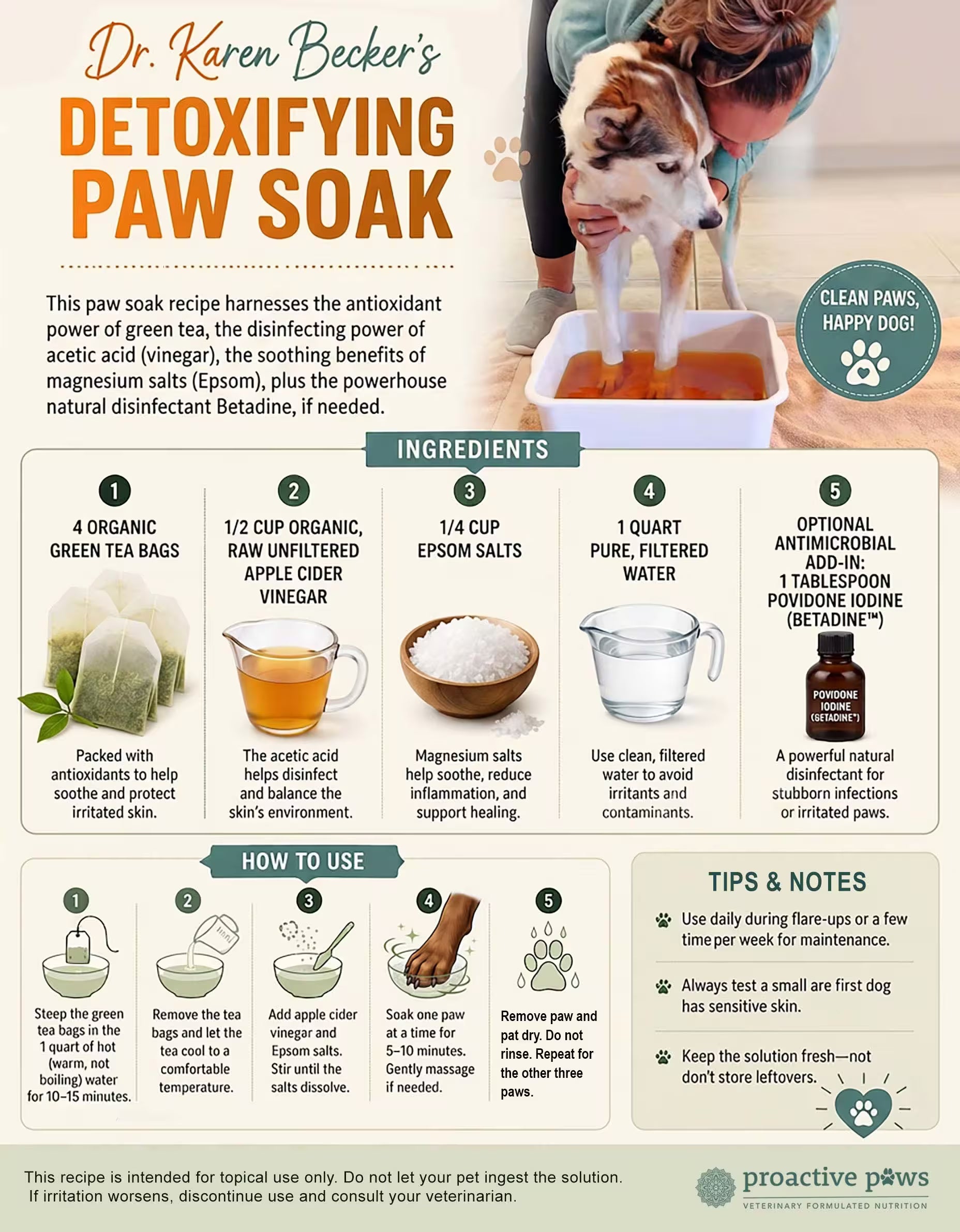
Wipe your dog's paws every single time they come inside; this alone meaningfully reduces the chemical load being tracked in and then groomed off later.
Glyphosate has become the most heavily used herbicide in modern agriculture. It's sprayed on crops, golf courses, residential lawns, school grounds, and in parks. Because of its widespread use, complete avoidance is nearly impossible.
Rather than attempting dramatic "cleanses," I prefer supporting the body's own detoxification pathways continuously. Experimental studies investigating glyphosate toxicity have repeatedly demonstrated that NAC reduces oxidative stress markers, while protecting liver, kidney, and nervous tissue from injury. NAC works best as part of a comprehensive nutritional strategy rather than a standalone solution.
Other nutrients I frequently recommend include glutathione, glycine, sulforaphane-rich broccoli sprouts, milk thistle, TUDCA, taurine, superoxide dismutase (SOD), and humic and fulvic acids.
Take a hard look at your dog's diet, too. Highly processed commercial foods carry their own burden of advanced glycation end products and other contaminants that accumulate over a lifetime, so shifting toward fresher, whole-food nutrition matters. If cost is a barrier to prepared fresh diets, and it often is, home cooking is a completely legitimate alternative. Dr. Hazzah often incorporates healing foods and traditional Chinese medicine principles into her recipe recommendations, favoring cooling proteins like turkey, pork, and white fish, along with more neutral options like beef, for cancer patients, who frequently run hotter constitutionally, while being more cautious with warming proteins like venison, chicken, and lamb in that population.
The Fine Needle Aspiration Myth I Want to Put to Rest
Here’s a myth I wish would disappear from the pet health world. The claim goes something like this: “Don’t let your vet aspirate that lump. The needle will spread the cancer.” I understand why it would be scary. If a mass is potentially cancerous, the idea of putting a needle in it seems counterintuitive, like the cancer will leak out and spread. So I asked Dr. Hazzah to settle this once and for all on the record, and her answer was immediate and unequivocal: “It's a myth.” There is no research supporting it.
She's right, of course, and science backs her up. A systematic review examining veterinary and human case reports, clinical studies, and experimental animal models specifically evaluating whether biopsies affect a tumor's metastatic potential found only two veterinary case reports of needle tract metastasis ever, both involving urogenital tumors that require more invasive biopsy techniques, out of the enormous volume of biopsies performed in veterinary practice every single day. The researchers concluded that there is no evidence of a general increase in distant metastasis resulting from these biopsies, in either people or animals, and that the overall risk is negligible compared with the diagnostic value of obtaining tissue.7
Dr. Hazzah advocates fine needle aspirates in her own practice. As she put it, veterinarians aren’t psychic. Neither am I. Without cytology, you're just guessing, and you should never begin a treatment plan, conventional or holistic, based on a guess. Diagnosis doesn’t obligate you to pursue a particular treatment. It gives you information so you can make the best possible decision for your pet. Aspirating lumps means knowing what you’re treating sooner rather than later, giving you the longest possible treatment runway.
What an Integrative Protocol Looks Like
I agree with Dr. Hazzah’s approach, which is built around three broad pillars:
-
Supporting immune function
The immune system plays an important role in recognizing and responding to abnormal cells. Supporting immune resilience means looking at nutrition, gut health, sleep, stress, inflammation, and appropriate targeted therapies.
-
Managing excessive inflammation
Chronic inflammation creates an environment that can contribute to tissue dysfunction and metabolic stress. Nutritional and therapeutic strategies promote a healthier inflammatory balance.
-
Targeting the individual cancer
This is perhaps the most important piece of the puzzle. Lymphoma isn't the same disease as hemangiosarcoma. A mast cell tumor isn't the same as osteosarcoma. And a dog receiving chemotherapy doesn't have the same needs as a dog receiving palliative care.
The cancer type, stage, grade, treatment plan, and individual patient all matter. That's why there is no single "natural cancer protocol."
Natural Therapies Sometimes Hinder Conventional Ones
The hypo-additive effect is what happens when adding a supplement, herb, or other therapy interferes with a conventional treatment's mechanism of action, rather than supporting it. Natural doesn’t mean harmless, and more isn’t better.
Consider cyclophosphamide, a chemotherapy drug commonly used in the CHOP protocol for canine lymphoma.8 One of its metabolites, acrolein, contributes to bladder toxicity. Acrolein does contribute to the drug's anti-tumor effect. Still, it's also directly responsible for a painful, sometimes serious complication called hemorrhagic cystitis, essentially bladder irritation and bleeding caused by oxidative damage to the bladder lining.
This is exactly where a well-meaning supplement choice can create a problem. Glutathione is one of the most powerful antioxidants, and I'm an advocate for it in appropriate contexts, including supporting detoxification during chemotherapy. But glutathione and related thiol compounds work in part by binding and neutralizing acrolein, which is the exact strategy used pharmaceutically to protect the bladder during this type of chemotherapy.9
Giving a strong antioxidant like glutathione at the wrong time, or in high enough doses, could theoretically blunt some of the very free-radical activity that helps this chemotherapy do its job against cancer cells, even while appearing to be a purely protective, supportive choice.
There is wisdom in being intentionally cautious with high doses of strong antioxidants like vitamin E, vitamin C, glutathione, resveratrol, and CoQ10 in pets actively undergoing chemotherapy regimens that rely partly on oxidative mechanisms.10Omega-3 fatty acids are a notable exception. Research suggests their benefit profile, including genuine anti-cancer properties11 documented in multiple studies,12 doesn't carry the same interference risk, likely because their primary mechanisms of action differ meaningfully from classic antioxidant free-radical scavenging.
What About Cannabis?
Cannabis is another area where I encourage pet parents to slow down before adding anything. Research into cannabinoids and cancer is fascinating, but also complicated. There are questions about dose, formulation, tumor type, immune function, drug metabolism, and interactions with conventional treatments.13 The overall picture remains genuinely mixed, and some analyses have found no significant negative interaction.
If your dog is receiving immunotherapy, don’t assume that cannabis is automatically compatible because it’s “natural.” Ask your veterinary oncologist first.
Cancer Prevention Starts Long Before Diagnosis
If I could change one thing about how we approach cancer in dogs, it would be to move the conversation more upstream. We can’t control genetics. We can’t prevent every cancer. And we can’t promise that a perfectly fed, perfectly exercised, and emotionally supported dog will never develop a tumor. But we can influence the environment our dogs live in.
We can keep learning what’s normal for our dogs so we can better recognize when something shifts. The earlier we notice, the more options we have. One of the most empowering things you can do for your dog is know their normal. Run your hands over their body regularly. Know what her normal mammary tissue feels like. Check for new lumps or changes. Pay attention to mobility. Watch her appetite and elimination. Look inside her mouth. When you notice a change, don’t talk yourself out of getting it checked.
Replace Fear With Facts
Cancer is frightening; I don’t want to minimize that. But fear serves us best when it turns into informed action, not avoidance or guesswork. Know the early warning signs. Take environmental exposure seriously. If your dog spends a lot of time on chemically treated lawns, take reasonable steps to reduce exposure.
Our pets can’t tell us when something isn’t right. So we have to pay attention. Early recognition, appropriate diagnostics, environmental awareness, sound nutrition, and carefully coordinated care can lead to more informed choices and more good days with our beloveds.
Sources and References:
- 1 Dobson JM. Breed-predispositions to cancer in pedigree dogs. ISRN Vet Sci. 2013 Jan 17;2013:941275. doi: 10.1155/2013/941275. PMID: 23738139; PMCID: PMC3658424.
- 2 Tindle AN, Krueger LA, Swafford BJ, Mani E, Danielson C, Labadie J, et al. Genotoxic exposures to volatile organic compounds in golden retrievers with and without multicentric lymphoma. Front Vet Sci. 2026;13. doi:10.3389/fvets.2026.1783854.
- 3 Tindle AN, Trepanier LA. Whole blood DNA damage precedes a diagnosis of canine multicentric lymphoma and correlates with environmental chemical exposures. Vet Comp Oncol. 2025. doi:10.1111/vco.70010
- 4 Glickman LT, Raghavan M, Knapp DW, Bonney PL, Dawson MH. Herbicide exposure and the risk of transitional cell carcinoma of the urinary bladder in Scottish Terriers. J Am Vet Med Assoc. 2004;224(8):1290-1297
- 5 Takashima-Uebelhoer BB, Barber LG, Zagarins SE, Procter-Gray E, Gollenberg AL, Moore AS, Bertone-Johnson ER. Household chemical exposures and the risk of canine malignant lymphoma, a model for human non-Hodgkin's lymphoma. Environ Res. 2012;112:171-176. doi:10.1016/j.envres.2011.12.003
- 6 Environmental Toxicology and Chemistry, 01 July 2026
- 7 Klopfleisch R, Sperling C, Kershaw O, Gruber AD. Does the taking of biopsies affect the metastatic potential of tumours? A systematic review of reports on veterinary and human cases and animal models. Vet J. 2011;190(2):e31-e42. doi:10.1016/j.tvjl.2011.04.010
- 8 Rebhun RB, Kent MS, Borrofka SA, Frazier S, Skorupski K, Rodriguez CO. CHOP chemotherapy for the treatment of canine multicentric T-cell lymphoma. Vet Comp Oncol. 2011 Mar;9(1):38-44. doi: 10.1111/j.1476-5829.2010.00230.x. PMID: 21303452.
- 9 Cavalletti E, Tofanetti O, Zunino F. Comparison of reduced glutathione with 2-mercaptoethane sulfonate to prevent cyclophosphamide-induced urotoxicity. Cancer Lett. 1986 Jul;32(1):1-6. doi: 10.1016/0304-3835(86)90032-7. PMID: 3091245.
- 10 Martinez, P.; Mosqueira, E.A.M.; Gillot, L.; Makis, W.; Peavler, C.; Vega-Galvez, A.; Joulia, F.; Grant, W.B. The Redox Paradox of Natural Supplements in Cancer: A Narrative Review to Guide Clinical Practice. Antioxidants 2026, 15, 809. https://doi.org/10.3390/antiox15070809
- 11 Khadge S, Thiele GM, Sharp JG, et al. Long-chain omega-3 polyunsaturated fatty acids decrease mammary tumor growth, multiorgan metastasis and enhance survival. Clin Exp Metastasis. 2018;35(8):797-818
- 12 Magalhães TR, Lourenço AL, Gregório H, Queiroga FL. Therapeutic Effect of EPA/DHA Supplementation in Neoplastic and Non-neoplastic Companion Animal Diseases: A Systematic Review. In Vivo. 2021 May-Jun;35(3):1419-1436. doi: 10.21873/invivo.12394. Epub 2021 Apr 28. PMID: 33910819; PMCID: PMC8193331.
- 13 Calheiros LGRdM, Pedro G, Oliveira da Silva T, Amorim RM, Alves CEF, Laufer-Amorim R. In Vitro Antitumor Effect of Oils Rich in CBD and THC Cannabis Extract in Canine Prostate Carcinoma Cell Lines. Veterinary Sciences. 2024; 11(10):501. https://doi.org/10.3390/vetsci11100501
About Karen Shaw Becker, DVM, CVH, CVA, CCRT
Veterinarian Dr. Karen Shaw Becker believes biologically appropriate food and an animal's immediate environment are essential in determining health, vitality, and lifespan. She has spent her career as a wildlife and exotic animal veterinarian and small animal clinician, empowering animal guardians to make intentional lifestyle decisions to enhance the well-being of their animals.


