



Story Highlights
- Canine Cognitive Dysfunction (CCD) becomes increasingly common with age, yet many early signs are mistaken for "just getting old."
- New research shows that oxidative stress, chronic inflammation, poor mitochondrial function, and abnormal protein accumulation all contribute to brain aging.
- Studies demonstrate that nutrition, antioxidants, omega-3 fatty acids, medium-chain triglycerides (MCTs), SAMe, Alpha GPC, exercise, and environmental enrichment can significantly improve cognitive function in many senior dogs.
- The earlier brain-supportive therapies begin, the greater the opportunity to preserve memory, learning, and quality of life.
"He's Just Getting Old" Isn't Always the Whole Story
Is your senior dog sleeping more during the day, wandering the house at night, forgetting daily routines, or seeming a little off lately? These changes aren’t automatically a normal part of aging. For some dogs, they’re the early signs of Canine Cognitive Dysfunction (CCD), also known as Canine Cognitive Dysfunction Syndrome (CCDS). This progressive neurodegenerative condition closely resembles Alzheimer's disease in people1. Some dogs begin developing it as early as nine years old.
Nearly 20% of dogs between 11 and 13 years of age are affected by CCD, and in dogs older than 15, it’s a staggering 68%. Veterinarians often diagnose CCD by looking for a characteristic pattern of behavioral changes known as DISHAA2:
- Disorientation — getting lost in familiar places, staring at walls, or seeming confused about routine surroundings
- Interaction changes — withdrawing from family members or other pets, or becoming unusually clingy
- Sleep-wake cycle disruption — restlessness, pacing, or vocalizing at night, and sleeping more during the day
- House-training loss — accidents indoors despite years of reliability
- Activity changes — reduced interest in play, walks, or things your dog used to love
- Anxiety and/or aggression — increased fearfulness, or irritability that wasn't there before
Several standard screening tools and tests are available to assess levels of disease and dysfunction3.
Communication Breakdown
Neurons are the specialized cells that allow the brain to communicate with the rest of the body. They transmit the signals responsible for memory, learning, movement, behavior, and countless other functions that keep your dog mentally and physically engaged with the world. As dogs age, however, these vital brain cells gradually become damaged and begin to die.
One of the major contributors to this decline is the accumulation of a protein called beta-amyloid. As beta-amyloid builds up, it creates a toxic environment that injures neurons and disrupts the connections between them.
Over time, as more neurons lose their ability to function or die, the brain becomes less efficient at processing information. This gradual breakdown in communication is what leads to many of the behavioral and cognitive changes pet parents recognize, including confusion, disorientation, altered sleep patterns, memory loss, and changes in social interactions.
Though not as common, cognitive dysfunction is also prevalent in cats older than 10 years of age4. For those going through this with their beloveds, my heart is with you. Watching the brain age faster than the body is so incredibly hard.
The Emotional Side of CCD
Researchers from the Dog Aging Project analyzed health and behavior data from more than 10,000 dogs5 aged eight and older to better understand how Canine Cognitive Decline, or Dysfunction (CCD), differs from normal aging. Rather than focusing only on memory loss, the researchers examined a wide range of behaviors commonly affected by aging brains.
Their findings showed that dogs with CCD experienced significantly more behavioral and emotional changes than healthy senior dogs. Compared to normally aging dogs, they slept more and were less interested in activities they once enjoyed. They seemed to forget previously learned behaviors and routines as though years of training had vanished.
The study also found that dogs with CCD showed higher levels of anxiety, experienced changes in aggression, and often ate less. In other words, cognitive dysfunction affects the whole dog, not just memory.
CCD symptoms tend to overlap, creating a broad spectrum of behavioral, emotional, and cognitive changes. This mirrors what physicians see in people with Alzheimer's disease, where patients often experience anxiety, sleep disturbances, personality changes, depression, irritability, and social withdrawal alongside memory loss.
How Aging Changes the Brain
We're learning more every year about how to protect the aging brain. Obviously, aging cannot be stopped, but a comprehensive review examining dozens of canine cognitive studies6 found that brain decline can be slowed and, in some cases, improved with proactive nutrition, lifestyle changes, and targeted supplementation.
The brain consumes enormous amounts of oxygen every single day. That makes it especially vulnerable to oxidative stress. As dogs age, several things begin happening simultaneously:
- Free radical damage accumulates
- Mitochondria become less efficient
- Chronic low-grade inflammation develops
- Blood flow to the brain decreases
- Neurons communicate less effectively with one another
- Toxic proteins called beta-amyloid gradually build up, disrupting neuron function and the connection between cells.
Think of it like rust slowly forming inside a finely tuned engine. The parts are still there — but communication becomes slower and less efficient over time. The encouraging part is that several of these processes respond to targeted nutritional and lifestyle support.
Early Signs of Cognitive Decline Are Easy to Miss
One reason CCD is underdiagnosed is because symptoms often appear gradually. It’s easy to miss them until significant brain changes have already occurred.
Here are eight common signs:
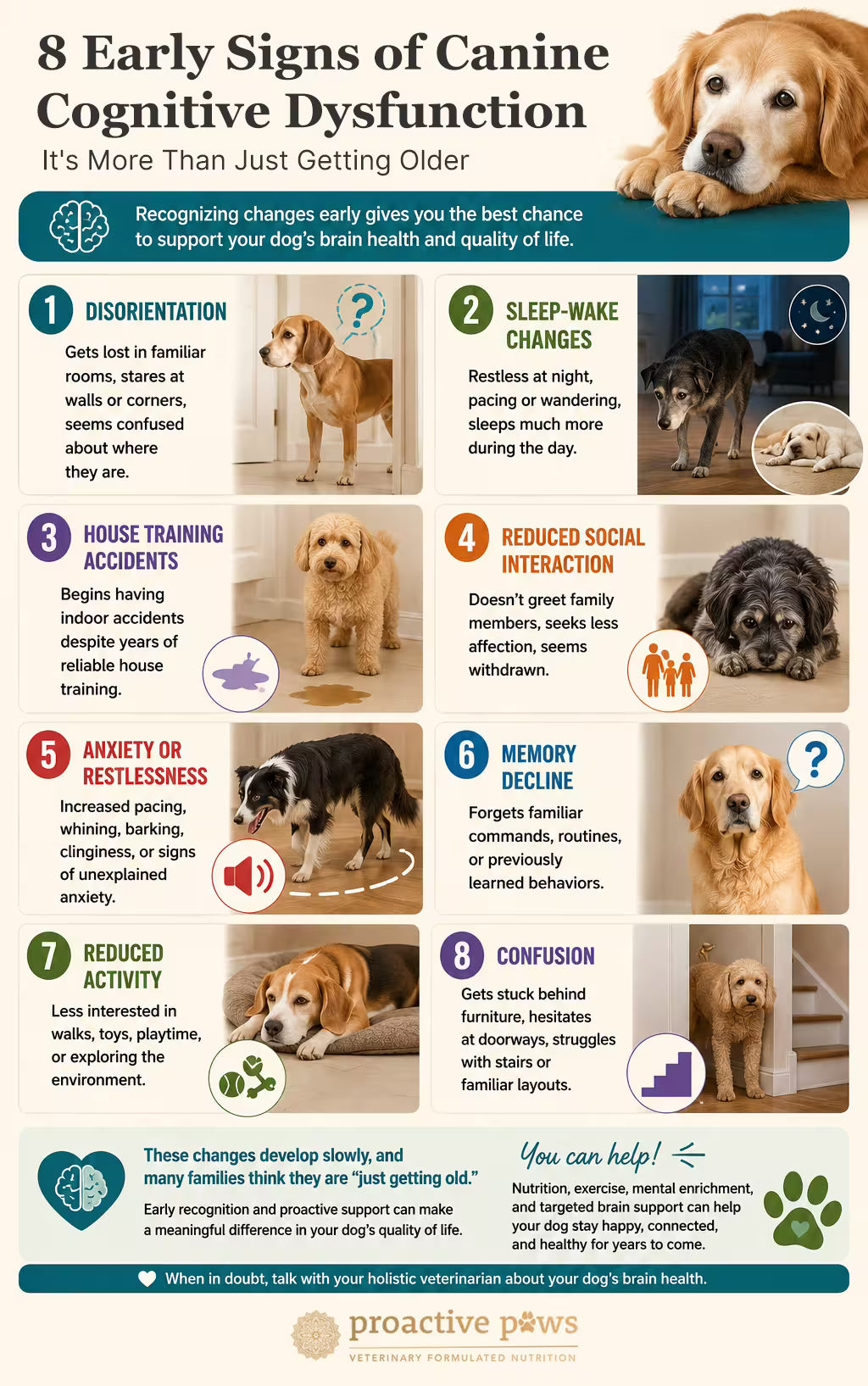
Because these changes develop slowly, many families don’t notice, or they adjust to them. Sometimes the easiest way to cope with a heartbreaking reality is to deny it as long as possible.
Early recognition gives us the greatest opportunity to offer as much help as we can. Even aging brains remain remarkably adaptable. This is neuroplasticity7 at its finest; the brain's ability to form new connections throughout life. Senior dogs continue making new neural pathways when given the proper support. That means your dog's brain is still working overtime.
Nutrition and Supplements That Support the Aging Brain
DHA: One of the Brain's Most Important Nutrients
DHA, docosahexaenoic acid (DHA), an omega-3 fat found in fish oil, helps protect the brain by supporting healthy neuron membranes, cell-to-cell communication, anti-inflammatory pathways, and synapse formation.
DHA-rich fish oil has been shown to improve learning and memory in puppies, while nutrient blends containing fish oil, B-vitamins, antioxidants, and arginine enhanced executive and visuospatial function in senior dogs and cats8. Research suggests DHA may reduce beta-amyloid accumulation, the same protein associated with Alzheimer's disease.
One six-month study combining DHA with naturally occurring sphingolipids significantly improved learning ability in aging Beagles while producing measurable changes in brain chemistry9. Studies in both puppies and senior dogs show that dogs receiving DHA have better memory, learning ability, vision, and overall cognitive function than dogs that don't receive enough DHA10.
MCTs: An Alternative Fuel Source for the Brain
As dogs age, their brains often become less efficient at using glucose for energy, like trying to power your home with failing electrical wiring. Energy doesn't arrive where it's needed. Medium-chain triglycerides (MCTs) offer an alternative: they’re converted into ketones, a fuel source aging brain cells can use efficiently11.
Several studies found that dogs receiving MCT supplementation showed significant improvements in attention, memory, learning, and problem-solving.
One clinical study involving 87 senior dogs demonstrated improvements across all six major signs of cognitive dysfunction after only 90 days when MCTs were combined with a brain-supportive nutrient blend12.
MCTs are generally palatable and well tolerated when introduced slowly, but some dogs can experience unpleasant side effects such as vomiting, increased gas, or diarrhea13. Start low and go slow.
SAMe: A Long-Standing Favorite
I've recommended S-adenosylmethionine (SAMe) for many years for its role in liver detoxification and methylation. It also supports brain function.
In one placebo-controlled study, dogs receiving SAMe experienced14:
- Improved awareness
- Increased activity
- Better responsiveness
- Greater overall mental function
Over 40% of treated dogs experienced more than a 50% improvement in cognitive impairment scores. It’s one of my favorite science-based supplements for cognitive benefits in senior pets.
The New Kid on the Block: Alpha-GPC
Alpha-glycerylphosphorylcholine is a naturally occurring choline compound that crosses the blood-brain barrier and serves as a direct precursor to acetylcholine, the neurotransmitter most depleted in aging brains, and the same one targeted by conventional cognitive dysfunction drugs.15,16 In animal models, alpha-GPC increased acetylcholine release in the hippocampus, facilitated learning and memory, reduced age-dependent structural brain changes, and upregulated brain-derived neurotrophic factor (BDNF), a key protein for neuronal survival and new cell growth17.
Alpha-GPC also reduced neuroinflammation, protected against blood-brain barrier breakdown, and promoted hippocampal neurogenesis in animals with cognitive impairment18. A systematic review and meta-analysis of human clinical trials confirmed that alpha-GPC significantly improved cognition, behavior, and functional outcomes in patients with dementia, both alone and in combination with standard medications19. For aging dogs showing signs of confusion, disrupted sleep cycles, or loss of learned behaviors, alpha-GPC offers a well-tolerated, evidence-informed option to support cholinergic function and slow cognitive decline.
Movement Is Medicine for the Brain and Body
Exercise isn’t just for the body. Researchers studying more than 11,500 companion dogs found that physically active dogs20 had better mental condition, slower progression of cognitive decline, and a lower likelihood of developing CCD in the first place. Data from the Dog Aging Project found that inactive dogs were over six times more likely to develop cognitive dysfunction than highly active dogs21.
Movement increases blood flow, oxygen delivery, mitochondrial function, and boosts the production of growth factors that nourish neurons. That doesn’t require high-intensity, exhausting exercise. Regular activity throughout the day can also ease the anxiety that often accompanies CCD.
Even when your senior seems completely uninterested in a real walk, a strolling sniff walk “sniffari” is helpful for you both.
Nose Work Is Brain Work

Dogs experience the world nose-first. Their olfactory system has direct neural connections not just to scent-processing areas, but to the limbic system (which governs emotion), and other brain areas involved in learning and movement22. Though your senior may no longer seem interested in going on walks the way they once did, slow sniff walks tap into a natural, species-typical behavior that’s considered essential for canine welfare.
Research shows that olfactory experience physically reshapes the brain. Prolonged exposure to varied scents increases brain-derived neurotrophic factor (BDNF), sometimes called "fertilizer for the brain,"23 which supports the survival of existing neurons, encourages the growth of new ones, and strengthens the connections between them. BDNF plays a central role in learning, memory, emotional regulation, and stress recovery.
Environmental enrichment, including scent work, raises BDNF in brain regions tied to emotional regulation. Pairing exercise with enrichment appears to boost this effect even further.
Simple Ways to Add Mental Enrichment
The brain also needs mental challenges.
- Food puzzles
- Scent games
- New walking routes
- Obedience practice
- Hide-and-seek
- Social interaction
Think of mental enrichment as physical therapy for the brain. You really can teach an old dog new tricks.
The Gut-Brain Axis: An Emerging Frontier
An exciting area of canine cognitive research doesn't involve the brain directly; it starts in the gut. Over the past decade, researchers have mapped the gut-brain axis, the constant communication loop between the trillions of bacteria in your dog’s intestinal tract and the brain. Gut bacteria living in your dog's intestinal tract produce neurotransmitters, regulate inflammation, influence immune function, and even affect how the brain ages. When the microbiome becomes imbalanced, known as dysbiosis, chronic inflammation and oxidative stress increase, both of which are linked to cognitive decline.
Canine probiotic research is still rather young, but one strain, Lactiplantibacillus plantarum LP815, a GABA-producing Lactobacillus strain, is receiving increasing attention in veterinary research.
This LP815 probiotic for dogs is particularly notable for its role in supporting neurotransmitter balance. GABA is a key inhibitory neurotransmitter that helps the brain settle, regulate excitability, and maintain emotional balance24.
Early studies on LP815 show it can increase GABA production in the gut, which can support calmer behavior, improved stress responses, and a more stable mood in dogs25.
Fecal Microbiota Transplantation: Poop for Thought
A small pilot study evaluated fecal microbiota transplantation (FMT) in 11 dogs with canine cognitive dysfunction (CCD) to see whether improving the gut microbiome could also improve brain function26. Ten of the 11 dogs tolerated the treatment well, with only one dog withdrawn because of gastrointestinal side effects. Among the six dogs whose owners completed the full 90-day evaluation, four showed meaningful improvements in cognitive function, while two experienced worsening symptoms.
Although the study was small, the findings provide promising early evidence that restoring a healthier gut microbiome through FMT may become a valuable tool for supporting brain health and slowing cognitive decline in aging dogs.
My Brain Support Action Plan
A cognitive support program for senior pets, especially those with CCD, should support the whole body, not just the brain.
- Fresh, anti-inflammatory nutrition: Whole-food diets provide phytonutrients, antioxidants, healthy fats, and fewer inflammatory ingredients than ultra-processed foods.
- Omega-3 fatty acids: Especially DHA and EPA from marine sources.
- Antioxidants: A colorful variety of vegetables, berries appropriate for dogs, vitamins C and E (when indicated), and other antioxidant-rich foods help neutralize free radicals.
- Mitochondrial support: Healthy mitochondria produce the energy every brain cell needs.
- SAMe: Particularly valuable for senior pets needing liver and cognitive support.
- MCTs: An alternative fuel source for brains that are losing efficiency with glucose.
- Alpha GPC: It fuels the production of acetylcholine.
- Daily movement: Age-appropriate exercise for circulation, mood, and cognition.
- Mental stimulation: Learning itself helps preserve brain function.
- Quality sleep: The brain does essential repair and waste-clearing work during rest.
Medical Management of Severe Symptoms
Lifestyle changes, environmental enrichment, nutrition, and targeted supplements should always form the foundation of a comprehensive treatment plan. But for dogs experiencing significant anxiety, medications such as trazodone and gabapentin can provide relief alongside these strategies27. There’s no shame in using every safe tool available to keep your dog comfortable.
There Is Real Reason for Hope
Growing older is inevitable. Growing older well is something we can influence. Science keeps giving us more tools to work with. The earlier you start supporting your dog’s brain and body, ideally before their senior years, the more resilience you can build before symptoms begin to appear. Prevention is always more effective than trying to reverse advanced degeneration.
Every fresh, nutritionally balanced meal, walk (or unhurried sniffari), and loving interaction is a small deposit toward your dog’s quality of life and longevity.
You don’t have to have all the answers today. But you have to start somewhere, and know that somewhere is enough for today.
Sources and References:
- 1 Vet Sci 2025 Aug 20
- 2 JAVMA 2026 Apr 01
- 3 Front Vet Sci 2024 May 21
- 4 J Feline Med Surg 2010 Nov 12
- 5 GeroScience 12 January 2026
- 6 AVMA 01 August 2025
- 7 Nature 06 August 2019
- 8 J Am Vet Med Assoc. 2012 Sep
- 9 Frontiers Veterinary Science 12 July 2022
- 10 Frontiers Veterinary Science 12 July 2022
- 11 Pan Y, et al. Medium-chain triglycerides improve cognitive function in aging dogs.
- 12 AVMA 01 August 2025
- 13 Animals (Basel)2022 Jun 26
- 14 Vet Ther 2008 Summer
- 15 Neuropsychiatr Dis Treat 2026 May 19
- 16 Curr Alzheimer Res 2013
- 17 Brain Res 2022 Jul 1
- 18 Brain Res 2017 Jan 1
- 19 J Alzheimers Dis 2023
- 20 Front. Vet. Sci., 27 April 2026
- 21 Nature 25 August 2022
- 22 Journal of Neuroscience. 2022
- 23 European Journal of Neuroscience. 2022
- 24 Animals (Basel). 2020 Aug 10
- 25 Animals (Basel). 2025 Aug 4
- 26 JAVMA 2026 June 10
- 27 Can Vet J 2021 Sep
About Karen Shaw Becker, DVM, CVH, CVA, CCRT
Veterinarian Dr. Karen Shaw Becker believes biologically appropriate food and an animal's immediate environment are essential in determining health, vitality, and lifespan. She has spent her career as a wildlife and exotic animal veterinarian and small animal clinician, empowering animal guardians to make intentional lifestyle decisions to enhance the well-being of their animals.


